Particle Analysis Services
Home » Particle Analysis Services
Particle identification, surface analysis, and particle size analysis services from EAG Laboratories can help you determine the root cause of a product problem and evaluate corrective actions. Particulate material commonly shows up in raw materials, in-process samples, and finished products.
EAG’s scientists have analyzed many types of particulates found in (or on) coatings, plastics, food, consumer products, chemicals, pharmaceuticals, medical devices, semiconductors, batteries, consumer products, additives, adhesives and more.
Our particle analysis services labs have identified such materials as:
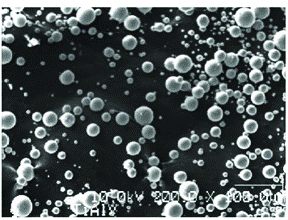
- Black specks in a white powder
- Particles in a bottle of pills
- A fine suspension of particles in a bottle of liquid
- Surface contamination
EAG Laboratories has developed expertise in identifying and characterizing particles of an unknown origin with individual and combined compositional analysis techniques in conjunction with expert data interpretation. We have developed a proprietary library of FTIR, LC-MS and GC-MS spectra to speed particle identification investigations.
We have used many different particle analysis techniques, including Fourier Transform Infrared Spectroscopy (FTIR), Raman Spectrometry, Auger Electron Spectroscopy, X-Ray Photoelectron Spectroscopy (XPS), X-Ray Fluorescence (XRF) and scanning electron microscopy–energy dispersive X-ray spectroscopy (SEM-EDS).
Once we determine the chemical nature of the particulate material, it may become important to gain a better understanding of the composition through further material characterization.
Armed with a particle analysis, we help our clients to:
- Determine the potential source of the identified material
- Compare the chemistries of two different particulates
- Confirm the identity of a suspected material
- Analyze the particle size and distribution
The technique of choice for analysis depends on many factors:
- What is known about the sample already?
- What needs to be quantified (major elements, minor elements, chemical components, or molecular/organic components)?
- Can destructive test methods be used?
- Is the sample unique?
- What is the particle size range?
- Is the particle in powder form or in suspension?
Surface Analysis
Elemental and chemical surface compositions are best measured using quantitative techniques with shallow information depths (<100Å), such as Auger Electron Spectroscopy (typically conductive materials only) or X-Ray Photoelectron Spectroscopy (all materials).
Bulk Analysis
Bulk composition is best determined with techniques that have large/deep information depths that ignore potential compositional variations at/on surfaces. Depth-specific information is typically not available with these methods. X-Ray Fluorescence (XRF) and scanning electron microscopy-energy dispersive X-ray spectroscopy (SEM-EDS) are non-destructive techniques that can provide elemental composition. Inductively Coupled Plasma Optical Emission Spectroscopy (ICP-OES) can quantify both major and minor elemental components. Fourier Transform Infrared Spectroscopy (FTIR) and Raman Spectroscopy are well suited to identify plastics, polymers and other organic materials.
Size Analysis
Particle size analysis techniques differ primarily in their measurement range, operating principles, and sample requirements. Choosing the right method depends on whether you need a fast bulk average (Laser Diffraction/Dynamic Light Scattering) or a detailed look at individual particle shapes (Microscopy/Scanning Electron Microscopy).
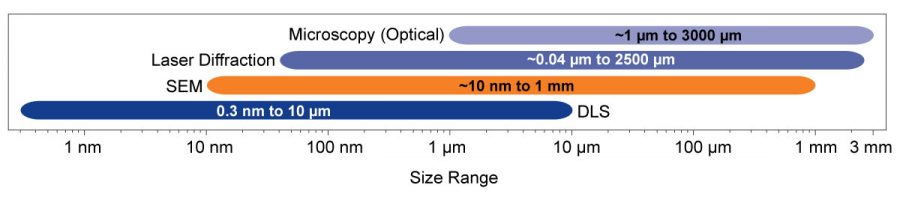
Technique
Laser Diffraction
DLS
Microscopy (Optical)
SEM
Size Range
~0.04 µm to 2500 µm
0.3 nm to 10 µm
~1 µm to 3000 µm
~10 nm to 1 mm
Measurement Basis
Light scattering angle/intensity
Brownian motion fluctuations
Direct image analysis
Electron beam imaging
Typical Application
Rapid bulk powder and dispersion QC
Nanoparticles and proteins in liquid
Checking for agglomerates and broad shapes
High-res shape, surface, and sub-micron details
Would you like to learn more about Particle Analysis Services?
Contact us today for your particle analysis needs. Please complete the form below to have an EAG expert contact you.